0°C
record temperature — Coningsby, Lincolnshire, 19 July 2022[1]
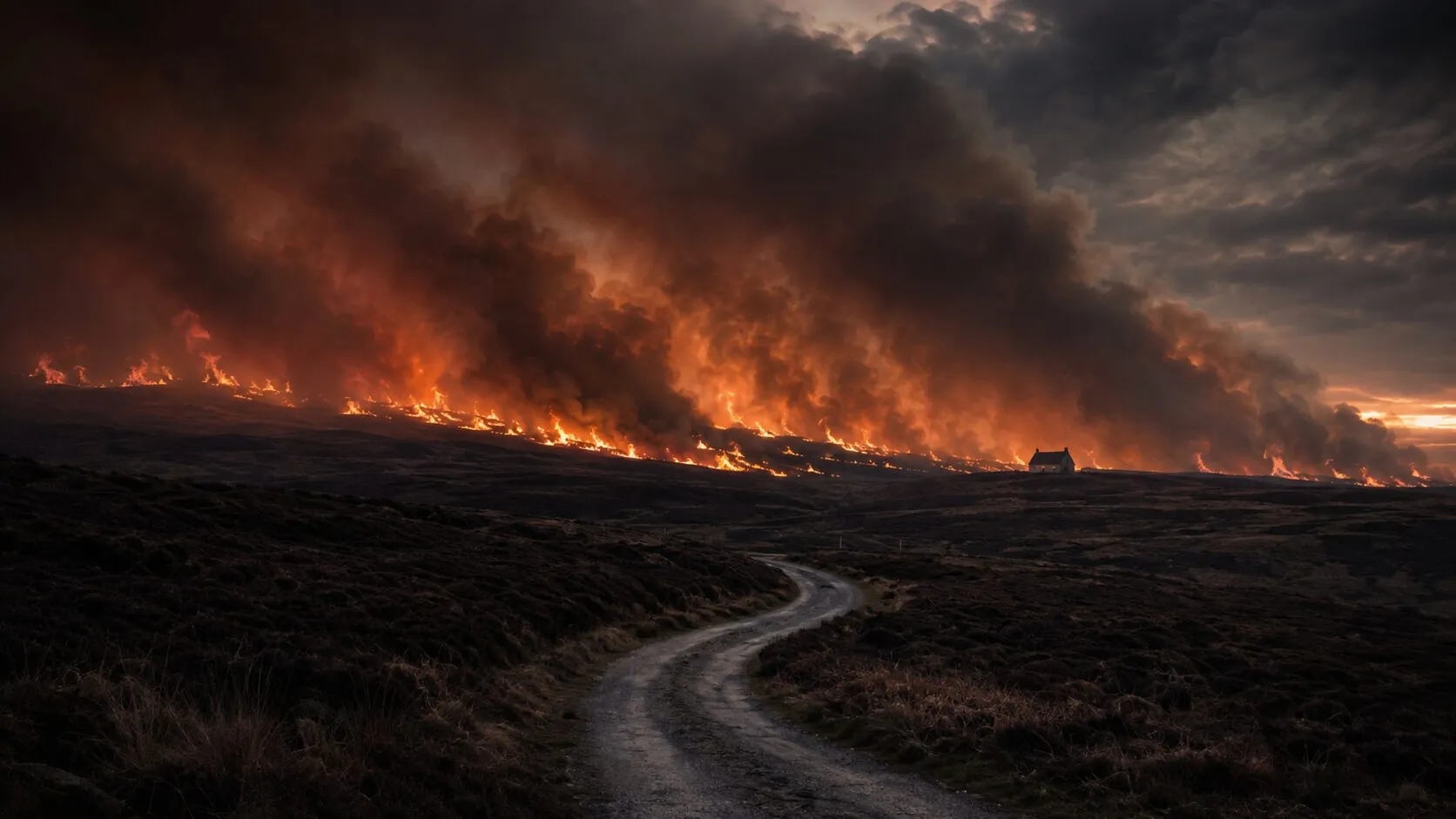
The UK was not traditionally a wildfire nation. That is changing. As summers get hotter, drier and more volatile, the vegetation that feeds a fire dries out for longer and the fire season stretches out. When a spark meets that fuel, the consequences reach the land, the economy and our taps.
The Met Office runs a dedicated fire weather service via the National Severe Weather Warning Service (NSWWS)[6], and its climate research tells a clear story. On 19 July 2022, Coningsby in Lincolnshire recorded 40.3 °C — the first time the UK exceeded 40 °C [1]. That same summer brought the country’s first-ever red extreme-heat warning[3] and the first hosepipe bans. A World Weather Attribution study found that without human-caused climate change, temperatures of 40 °C in the UK would have been extremely unlikely — extreme heat was made 10× more likely [11].
More recently, 2025 was the UK’s warmest year on record (mean 10.09°C, series back to 1884), also the sunniest year on record (1,648.5 hours)[2]. A Met Office rapid-attribution study found 2025’s record annual temperature was ~260 times more likely due to human-induced climate change; a summer as hot as 2025 is now 70 times more likely than in a natural climate[2]. The top ten warmest years have all occurred in the last two decades[2].
2025 was also the worst year for UK wildfires on record: 47,879 hectares burned, surpassing the previous record of 28,754 ha (2019) by more than 19,000 ha. 181 fires exceeded 30 hectares (previous record: 151, set in 2022)[10]. In 2022, the UK burned 20,362 ha across 151 fires >30 ha[9]. England burns on average ~4,600 ha per year in normal years (2009–2017 average) [5] — so 2025 represented a tenfold spike.
The pattern is not a string of unlucky seasons. It is a baseline shift: hotter, drier summers are becoming the norm, and with them a longer, more dangerous fire season that was almost unknown a generation ago.
Each dry summer makes the next fire more likely, harder to fight and more expensive to clean up.
The baseline shift — what Met Office fire-weather data now shows95% of European forest fires are human-caused[12]. In the UK, ordinary equipment and ordinary carelessness, meeting an ordinary dry day, are how most fires begin. None of these causes takes much to trigger one — and all of them are preventable. The 2019 Marsden Moor fire was started by a barbecue [8].
A wildfire’s speed is set by the fuel, its moisture and the weather. In dense forest it may crawl; in dry grassland it can race. Winds and rising heat carry firebrands — burning embers — ahead of the main front, starting new spot fires across roads, fences and rivers that would otherwise act as barriers.
The 2022 heatwave demonstrated the scale: the London Fire Brigade recorded its busiest day since World War Two on 19 July — 2,670 calls against a normal ~350 [4] — and attended 340 grassland and wildland fires in the first week of August, compared with 42 the same week in 2021 [4]. By the time a fire is reported, the front may already be moving faster than crews can reposition — which is why response depends on early detection and, above all, on having water on hand.
Breaking that chain is where prevention — and responsible water use — come in.